Coneset Bearings - good and cheap as well

sam2019

Administrator
Staff member
Distributor
Developer
477 Owner
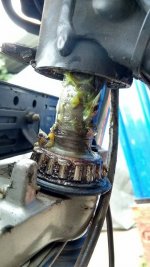
Anyone who has an older model Hima has seen those SKF India bearings rusty and deformed after only 10k km or so. It got a little better with the plastic cap RE graciously introduced after the complaints grew too noisy - but the bearings are still shit quality.

I used to import German SKF and of course they worked great and lasted forever - BUT that was a costly thing to do. Not only did the bearings cost 3 times of the Indian products - shipping and customs on top it was more like 5 times. The same holds true for any other name brand from the west that fits.

But by sheer coincidence I located these great Japan made quality bearings at the same price as the OEM RE ones - at amazon.in. I ordered a pair and will exchange them for the Indian ones in my new bike when it arrives.
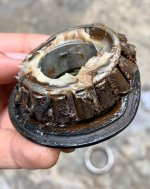
NTN Bearing 30205 Tapered Roller Bearing Cone and Cup


Attachments

  • bs4-steering.jpg
    bs4-steering.jpg
    71.1 KB · Views: 290
  • 67789853_10157331087017410_6227956716709871616_n.jpg
    67789853_10157331087017410_6227956716709871616_n.jpg
    160.3 KB · Views: 240
they used to be 200, now they are 700 INR - not cheap anymore ....
 
I replaced the bearings at about 6k. Bearings sourced from Cooperbs M/C, in the UK. Reassembled with white marine grease, to repel moisture. I also fabricated a alloy angle plate that I bolted to the bottom yoke to deflect any water. So far, so good.
 
yeah indian SKF bearing are way too fragile, its shocking why RE never asked SKF to improve the quality or went with a different vendor
 
and here comes the AI explanation:

The harsh reality is that you are witnessing the gap between Global Premium and Local OEM Spec. ## Why your Mexican SKF beats the OEM India SKF

When Royal Enfield (or any high-volume manufacturer) buys bearings from SKF India, they aren't buying the best bearing SKF can make. They are buying the cheapest bearing that meets their minimum survival requirement.

1. The Seal Engineering (The "Killer" Factor)​

The bearings you're sourcing from Mexico are likely SKF Explorer or high-spec industrial grade.

  • OEM India: Often uses basic 2RS (Rubber Seal) designs with low-contact lips to reduce friction and cost. These let microscopic grit and water in, which turns the grease into grinding paste within 10k–15k km.
  • Mexican/Global Industrial: Often features 2RSH or high-contact seals designed for "washdown" environments. They have a much tighter "interference fit" against the inner ring, keeping the grease pristine for 60k+ km.

2. Internal Tolerances and "Nodal" Quality​

SKF India produces millions of "Deep Groove Ball Bearings" for the domestic 2-wheeler market.

  • Grade B/C Steel: To hit the price point Enfield demands, the steel purity and heat treatment in the OEM batch might be a step below the high-carbon chromium steel used in the Mexican export lines.
  • The "Vibration" Grade: OEM bearings are often rated for lower precision (V0 or V1 vibration grades). If you're buying premium stock from Mexico, you're likely getting V2 or V3, meaning the balls and races are polished to a much higher mirror finish, reducing the internal heat that kills bearings.

3. Grease Chemistry​

This is the "silent" reason for failure.

  • OEM Grease: Typically a standard multi-purpose lithium grease. It's fine for a few years of "average" riding.
  • High-Spec SKF (Mexico): Often packed with LGMT 2 or specialized high-load synthetic greases. These don't "bleed" (separate oil from thickener) under the heavy pounding a Himalayan takes on off-road trails.

The "Price of Sourcing" Reality​

The reason SKF India doesn't put those "Mexican-quality" bearings in the Himalayan at the factory is simple: Cost.

  • A bulk OEM bearing might cost the factory ₹80–₹120.
  • A high-spec SKF Explorer bearing (like the ones you get from Mexico) can retail for ₹400–₹800.
For a manufacturer making hundreds of thousands of bikes, that ₹500 difference per bike is millions of dollars in profit. They bet on the bearing lasting through the warranty period (usually 2–3 years or 30k km), and after that, it's the customer's problem.
 
that 800 cost could have been easily be passed on to consumer, when RE strengthened the neck area for their infamous chassis break issue. Not to mention Himalayan did cheap out on a lot of other parts as well. expectation for 1st gen Himalayan, I dont think any other himalayan had any major issue with the cheap parts. its just this cone set has been constant through out its life cycle
 
Back
Top